The Vote · how a community reaches a decision

Decide together, and have it hold.

VoteCast does not replace your meeting. It is the step after one — where what the group worked out becomes a decision on the record, with the rules it was made under written down beside it.

Six ways to decide, from a simple poll to consent decision making — the sociocracy standard of no paramount objections. One person, one vote. Public proposals or members-only. Plain enough that nobody has to learn a governance vocabulary before they can take part.

One person, one vote Public or members-only Free for small groups
VoteCast · Consent · illustrative
Proposal · 014 Open · 2 days left

Adopt a rotating work-share schedule for the spring season

41 members eligible · 28 votes cast

Consent: the proposal passes unless a facilitator agrees an objection is serious enough to stop it. Nobody has to actively approve.

Illustrative — cast a vote to see the tally move Open ↗

"The vote is the easy part. What a community comes back to, years later, is the record."

Why decisions are where it breaks

Communities rarely fracture over the land.
They fracture over what everyone thought was agreed.

None of these look like a governance problem while they are happening. They look like a good meeting, a quiet member, a question nobody quite asked. The damage shows up much later, when the group needs to know what it decided and finds that the deciding was never written down.

01

The meeting decided. Then what?

A group talks something through and reaches what feels like agreement. Nobody writes down what exactly was agreed, who was in the room, or what would have counted as a no — because in the moment it seems obvious to everyone. Six weeks later two people remember two different decisions, both entirely sincerely, and there is nothing to check either one against.

The agreement was real. A record of it never existed.
02

Objections with nowhere to go

Someone has a genuine reservation and no channel that fits it. Saying it in the room feels like blocking the whole group; saying it afterwards feels like going behind their backs. So it stays unsaid — and comes back months later as resentment, instead of arriving now as a question that could still be answered.

The concern did not go away. It just arrived too late to help.

03

Nothing to point at afterwards

A year on, nobody can show what was agreed, who was entitled to decide it, or on what basis. Not because anyone acted badly — because it was never written anywhere that outlasts a chat thread. So the group starts the argument again from the beginning, with less patience than it had the first time.

The decision was made once and paid for twice.

A tool fixes none of this on its own. But most of it is invisible rather than unsolvable — and a thing a group can see is a thing it can change. VoteCast takes the part that can be written down, and leaves the conversation exactly where it belongs.

What VoteCast is, and isn't

The step after the conversation, never instead of it.

A tool that runs a community's decisions is easy to misread — as a rulebook, as a substitute for meeting, as a way of making the difficult part go away. Here is the line we hold.

It is A decision, written down.
  • The step after the conversation.

    The meeting is where a group actually works something out. VoteCast is where that becomes a decision on the record — the same agreement, written down, with the rules it was made under attached to it.

  • One person, one vote.

    Every member counts the same. No tokens, no weighting, no quiet advantage for whoever joined first or shows up loudest.

  • Six ways to decide, not one.

    A poll, a ranked election, a majority motion, consensus, consent. The method is chosen per decision, because a paint colour and a constitution are not the same question.

  • Explicit about its own rules.

    How many people must take part, what share passes it, when the tally becomes visible, what an absence means — each one a setting you choose on purpose, and each one published beside the result.

  • Readable without a glossary — and there is a glossary.

    Plain language throughout, and every term the platform uses is defined in public, so nobody has to take a governance vocabulary on trust before they can vote.

It is not And we would rather say so.
  • ×
    A replacement for the meeting.

    It never is, and it is not trying to be. Communities decide in conversation — around a table, in a circle, on a call. VoteCast comes after that, so the decision survives the week. If it ever replaced a conversation the group needed to have, it was used wrongly.

  • ×
    A DAO tool.

    No tokens, no treasury, nothing on-chain, no wallet required to sign up. Platforms built for crypto organisations were the thing we kept finding, and the thing we did not want.

  • ×
    A way to make objecting painless.

    A method can give a reservation a name and somewhere to go, which is more than most groups have. It cannot make raising one comfortable, and we would rather say that than imply otherwise.

  • ×
    Finished.

    One person, one vote is the only weighting that ships today. Delegation, subgroups and richer eligibility are named as future work rather than implied as present features.

Six ways to decide

A paint colour and a constitution
are not the same question.

Most tools hand you one voting rule and let you live with it, which is how a group ends up running its constitution the same way it picked a logo. VoteCast offers six. Pick one to see how it works, what a ballot looks like, and when a community would actually reach for it.

Poll

Choose among options

Everyone picks one option. The result shows how the group split — nothing passes and nothing fails.

How it works
  1. 1 The proposer writes the question and lists the options.
  2. 2 Each member picks one. One person, one vote.
  3. 3 The result records what share each option got, and which one led.
For example

Which weekend do we hold the spring work party?

What the ballot looks like

Which weekend do we hold the spring work party?

Saturday the 8th
Saturday the 15th
Saturday the 22nd

Illustrative — an example ballot, not a live proposal.

How it travels
Question posted Members pick one Shares recorded

Result: A tally. No pass, no fail — just where the group stands.

A community can use a different method for each kind of decision, and set which is the default for which. Every term above is defined in public at the VoteCast glossary ↗.

What it actually looks like

No governance dashboard.
Just the decision, and the record.

One page per proposal: what is being decided, who may decide it, how long is left, and — once it closes — the result alongside the rules it was measured against. Drawn here as wireframes; the live app is one click away.

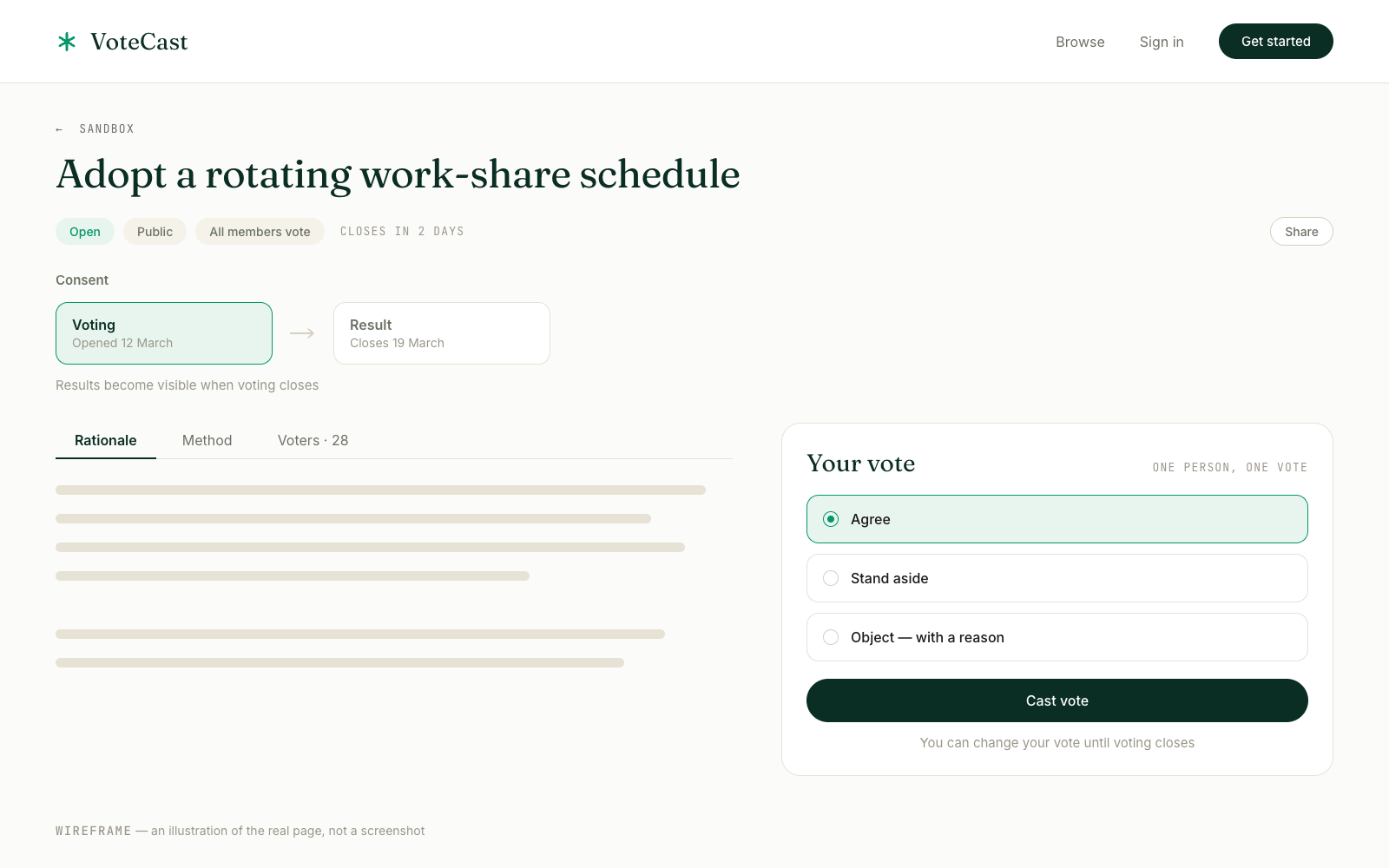
Wireframe of a VoteCast proposal open for voting: the motion, a consent ballot with agree, stand aside and object, and the time remaining
A proposal, open

What is being decided, the options, who may vote and how long is left — on one page, in plain words.

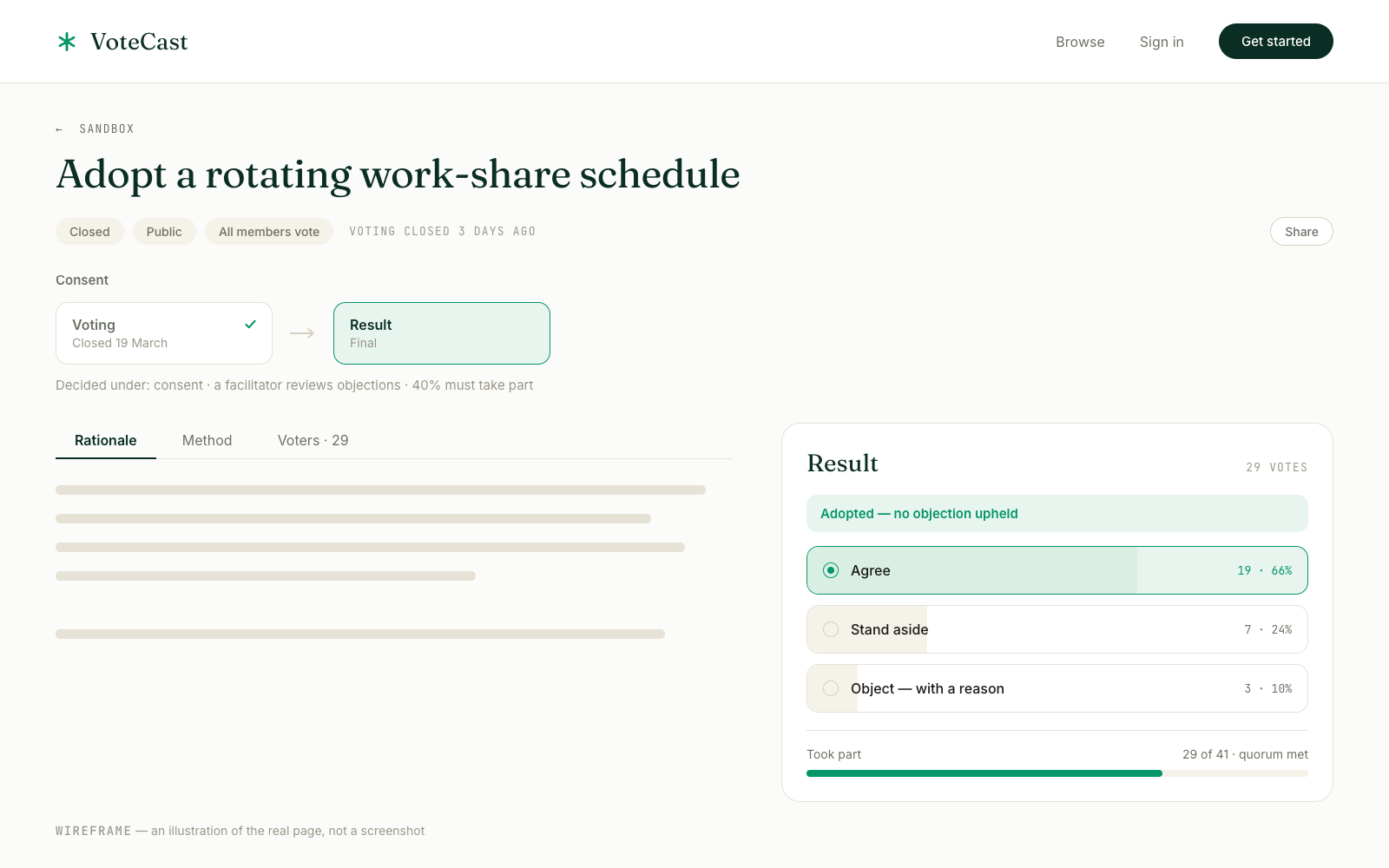
Wireframe of a closed VoteCast proposal: the final tally with each option’s share, alongside the rules it was decided under
A decision, closed

The result, and next to it the rules it was measured against. This is the page a group comes back to in a year.

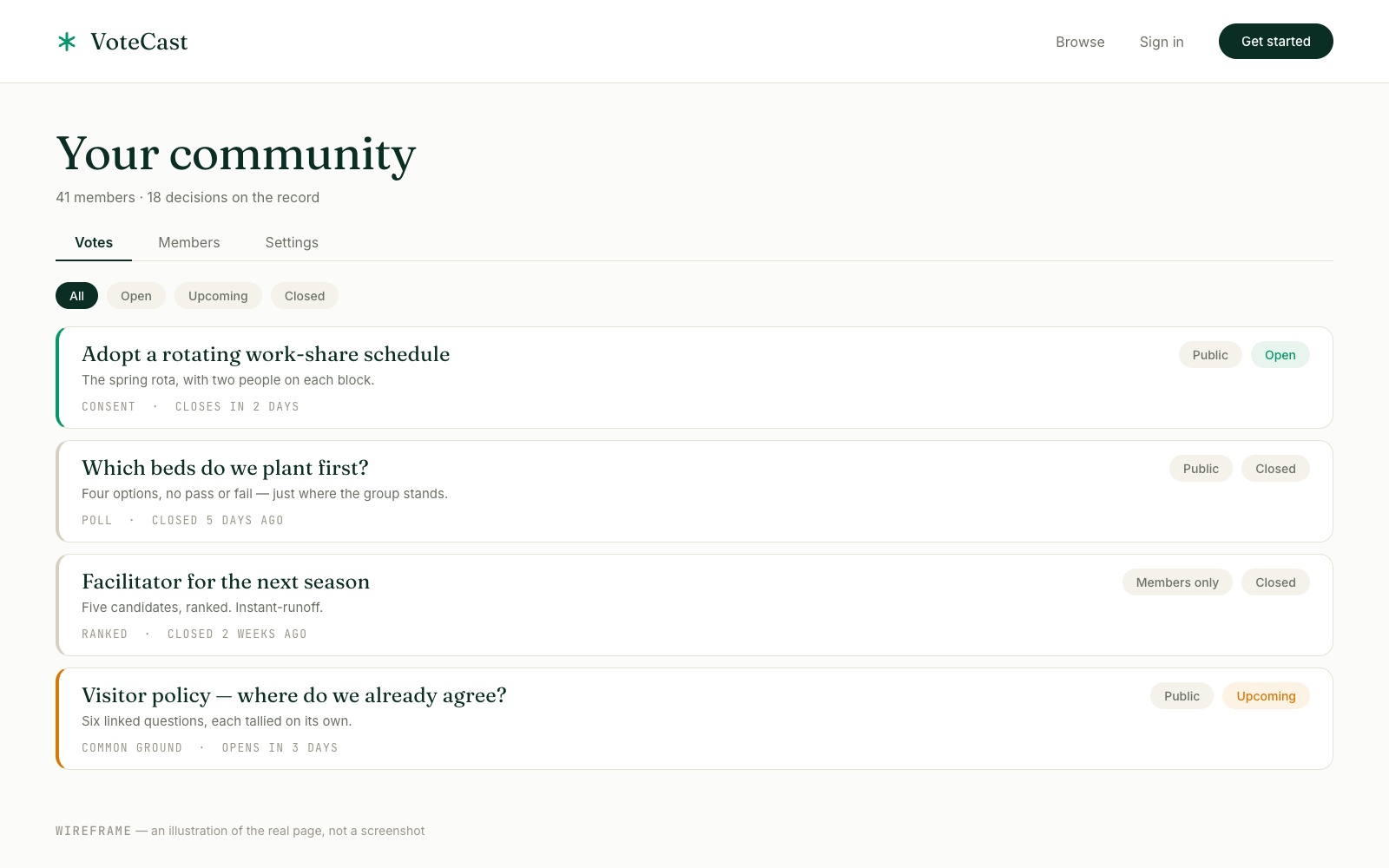
Wireframe of a VoteCast community page listing four proposals — open, closed and upcoming — each tagged with its voting method
A community, over time

Every decision the group has made, in order. The thing that was missing when it all lived in a chat thread.

How a decision travels

Six phases. Most decisions only use three.

A poll about a shared meal goes draft, voting, closed, and that is the whole life of it. The other three phases exist for the decisions that deserve the extra weight — and they are there before the argument, not improvised during it.

01
Draft

Written but not yet open. The proposer settles the wording, the options and the timing while it still costs nothing to change them.

02
Deliberation
Optional

A reading and discussion window before voting opens. Nothing is counted yet — which is exactly the point of having one.

03
Voting

The window is open and votes are counted. Depending on the settings the running tally is visible to everyone, or to nobody until it closes.

04
Objection window
Optional

For consensus methods: the result is held as provisional for a set period after voting, so a reasoned objection raised late can still stop it.

05
Ratification
Optional

A hold on a passed result before it takes effect — a cooling-off delay, a sign-off, or a veto window. If it is not confirmed, the record reads "not ratified" rather than "passed".

06
Closed

Every phase complete. The outcome is final, the tally and the rules it was measured against are on the record, and it stops being a matter of memory.

Phase names with a dotted underline open VoteCast's public glossary.

And ten outcomes at the end of it, not two — passed, failed, blocked, tie, no quorum, provisional, recorded, elected, not ratified, indeterminate. A proposal too few people voted on and a proposal the group rejected are different events, and the record says which one happened. Read what each one means ↗

The settings that decide fairness

There is no neutral default.
Only a default somebody chose.

Each of these settings has a real cost in both directions, and picking one is a decision about power, not a preference. So VoteCast asks you to set them deliberately, and publishes what you set beside the result — because a tally whose rules you cannot inspect is not transparency, it is just a number.

How many must take part

The minimum participation before a result counts at all — a quorum.

Set it high and one quiet month blocks everything. Set it low and five people decide for forty.

What share passes it

The bar the approving side of a motion has to clear — more than half, or at least two-thirds.

Two-thirds protects a minority from a thin majority. It also hands a determined third of the group a standing veto.

When the tally becomes visible

Whether the running count shows live, only once voting closes, or not at all.

Live results let people see where the group is heading. They also let people follow it rather than think.

Whether votes are secret

Whether other members can see how each person voted. Independent of when the totals appear.

Secrecy protects dissent. Openness makes people answerable for it. A community of forty rarely gets to have both.

What an absence means

On consent ballots, whether silence counts as consent or is simply left out.

Silence-as-consent lets a busy group decide anything. It also lets a decision pass that most of them never read.

Whether a vote can change

Whether a member may revise or withdraw their vote before the window closes.

Changeable votes let a discussion actually change minds. Fixed votes stop a last-minute stampede at the close.

Each heading opens VoteCast's own definition of that setting, so you can check what it does before you set it.

What no setting fixes
  • Whether a facilitator upholds an objection fairly — the tool records the judgement, it does not make it
  • Whether the people most affected were in the room, or on the roster, at all
  • Whether a proposal was written clearly enough to be voted on honestly
  • Whether the group will live by a result it does not like

A voting tool can make a group's rules explicit and hold it to them. Everything above still depends on the people in the room, and we would rather write that down than let the interface imply otherwise.

Why EcoHubs built a voting tool

We had decisions to make.
And nothing that fit.

VoteCast is not a side project. It comes straight out of what EcoHubs is for — and out of a problem we ran into ourselves, early, with nothing on the shelf that fit.

"To make regenerative community living — rooted in care for people, land, and life — structurally accessible, resilient, and replicable, reducing humanity’s dependency on extractive systems one community at a time."
EcoHubs Purpose Charter · RCOS Layer 0 · Identity
01
The purpose

Accessible and resilient, structurally.

Communities rarely come apart over land or money. They come apart over decisions nobody wrote down — who decided, on what basis, and whether that was the rule the last time too. Making that part workable is not a feature. It is most of what the charter is asking for.

Read the purpose charter ↗
02
Our own need

We needed it, and nothing fit.

EcoHubs decides in the open, and the RCOS Standard says a community should be explicit about how it decides — which is worth very little without somewhere to actually run it. What we found instead was built for DAOs and token holders: wallets, treasuries, governance dashboards. None of it was built for forty people sharing a valley.

Read about the RCOS Standard →
03
The network

A network is only as strong as its decisions.

A network of small, place-based hubs depends on each one being able to decide things without a crisis. Communities that are good at deciding together survive their disagreements; the ones that are not spend their years relitigating them. That is the difference between a network and a list of names.

Read the vision →
Who picks this up

Built for groups that decide together and have to live with it.

For intentional communities

Ecovillages, land projects, co-housing.

The work-share, the budget, who joins — decided in the circle, then written down where everyone can find it again in March.

For co-ops and non-profits

Member governance with a paper trail.

Motions, member votes and a record of who was eligible and what the bar was — the thing an assembly or an auditor eventually asks to see.

For online collectives

Open-source projects, guilds, creatives.

A group spread across eight time zones can still decide something, because a voting window does not require everyone awake at once.

For hybrid networks

Local chapters, one shared commons.

A vote can be opened to the whole community or to a named committee — and a committee result is measured against that committee, not quietly against everyone.

Where VoteCast sits in the EcoHubs project

The standard says what to make explicit.
The tool is where it actually runs.

VoteCast is deliberately narrow. It records decisions — it does not tell you what your decisions ought to be, it does not hold the conversation for you, and it will not find you the ground to make them on.

01 · Vision

A network of regenerative hubs.

Small, place-based communities, each adapted to its land and culture, woven into a shared commons that gets stronger over time.

Read the vision →
02 · VoteCast· you are here

Where the deciding is recorded.

Proposals, deliberation, six voting methods and a record everyone can read — so an agreement outlives the meeting it was made in.

Open VoteCast ↗
03 · RCOS Standard

What the rules should say.

The standard is where a community writes down which decisions need which method, who is eligible, and how conflict gets repaired.

Read about RCOS →

The standard writes the rule. The tool runs it. A rule nobody runs is a document, and a vote with no rule behind it is a headcount.

Honest questions, honest answers

About VoteCast, specifically.

Does this replace our meetings? +
No — and it should not. Communities decide in conversation: around a table, in a circle, on a call. VoteCast is the step after that. It takes what the group worked out and makes it a decision on the record, with the rules it was made under attached, so that in six months nobody has to reconstruct it from memory. Plenty of groups use it purely to confirm what a circle already reached, which is a perfectly good use of it. If it ever replaced a conversation you needed to have, it was used wrongly.
Do we need to be technical to use this? +
No, and that is close to the whole design brief. You start a community, invite people with a link, write what is being decided, and set when voting opens and closes. There are no wallets to install and no tokens to hold — signing up takes an email address and a password. Where the platform does use a precise word, such as quorum or objection window, it defines it on the spot and again in a public glossary you can read before signing up for anything.
Is it free? +
Yes for small groups. A community that has not been verified yet can hold up to 10 members and 50 proposals, which is enough to run real decisions for a while and work out whether the tool suits you. Verification is a manual review that lifts both caps — it exists to stop the platform being used as free spam infrastructure, not as a paywall in disguise.
Which method should we use? +
Start with the simplest one that fits the question. A Poll for choices with no pass or fail. Ranked when you are picking one thing from several. Approval for ordinary motions, at a majority or at two-thirds for agreements that should be harder to change than to make. Consensus or Consent for the decisions the whole group has to carry. The honest advice is to pick a default for each kind of decision now, while nothing is at stake, rather than during the argument.
Can results be hidden until voting closes? Can votes be secret? +
Both, and they are separate settings. When the tally becomes visible — live, on close, or only to facilitators — is one choice; whether other members can see how a particular person voted is another. You can run open votes with hidden totals, or a secret ballot with a live count. Hiding the running tally is the usual guard against people voting with the trend rather than with their judgement.
What actually happens if someone objects? +
It depends on the method, which is why the method is chosen per decision. Under Consensus, a reasoned objection blocks the proposal and a stand-aside does not. Under Consent, an objection has to be upheld by a facilitator to stand. Either way the objection is recorded with its reason, and the outcome reads blocked rather than failed — a distinction that matters, because a blocked proposal usually comes back rewritten and a failed one usually does not come back at all.
Is this a DAO tool? Do we need tokens or a wallet? +
No. There are no tokens, no treasury and nothing on-chain, and voting power is one person, one vote — every member counts the same. You sign up with an email address and a password. A wallet can optionally be connected as a way to sign in, for groups that already use one, but it is never required and it changes nothing about how a vote is counted.
Do we have to be part of EcoHubs to use it? +
No. VoteCast is built for any community that has decisions to make — intentional communities, cooperatives, non-profits, online collectives, networks with local chapters. EcoHubs built it and uses it, and nothing about it assumes you have read a word of the RCOS Standard.
How does VoteCast relate to the RCOS Standard? +
They are the two halves of one thing. The RCOS Standard is where a community writes down what its rules are — which decisions need which method, who is eligible, how conflict gets repaired. VoteCast is where those rules actually run. A rule nobody runs is a document; a vote with no rule behind it is a headcount. You want both.
Free for small groups

Have the conversation. Then write it down.

A community, a first proposal and an open vote take about ten minutes to set up. The methods, the settings and every word the platform uses are documented before you commit to any of it.

One person, one vote · Public or members-only · Every term defined in public

Stay close to the work

Letters from a young project.
Rare, but real.

We're early — a small project finding its shape. When something actually shifts — a new chapter of the RCOS Standard, a note from the Ecuador pilot, an invitation to gather — we'll write. No schedule. No filler.

RSS Feed
EcoHubs
EcoHubs Community

We are co-creating the RCOS Standard for regenerative living. Join us to design communities that thrive in harmony with nature.

DiscordMastodonFarcasterXYouTubeInstagramLinkedInGitHub
© 2026 EcoHubs.community · Built in the open, with care and regenerative principles.